Saturday, November 27, 2010

Cupcake Mania!


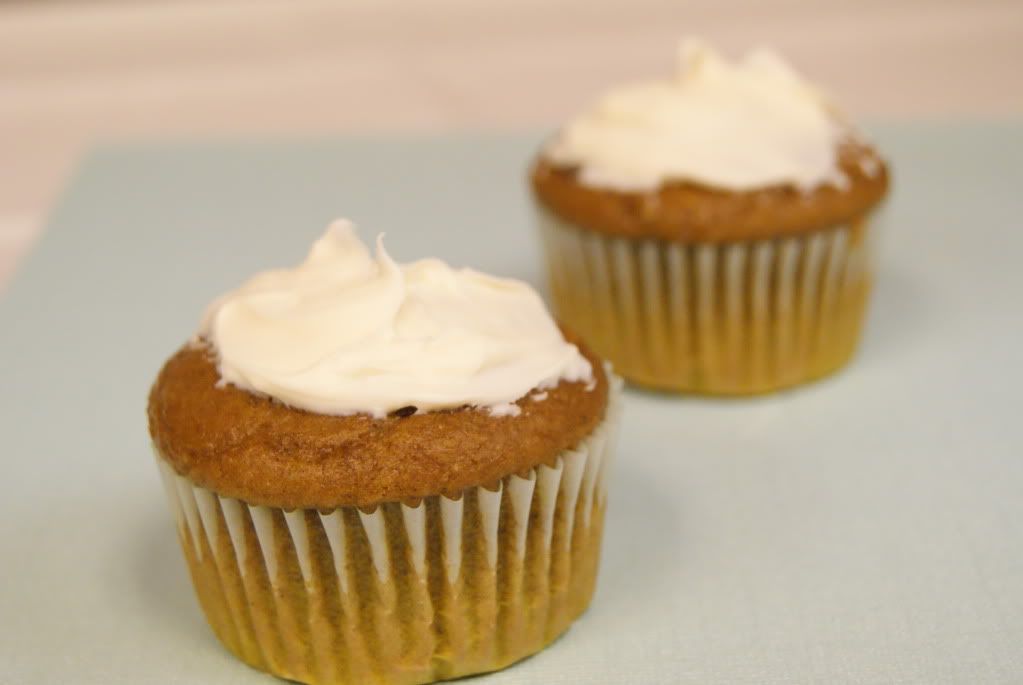
I have a confession. I love cupcakes. I love baking them, I love drawing them, I love writing about them, and unfortunately for my diet (which is on life support after the holidays!) I like eating them.

The night before Thanksgiving I came to a startling realization: I didn't have a lot longer to make pumpkin cupcakes before it'd be Christmas time. A matter of fact, I figured, I had about twenty four hours to get it done!

And of course, it being the eve of Thanksgiving, everyone else had the idea of using the kitchen as well. So unfortunately, cupcake baking was delegated to least important (bah, who needs sweet potato salad I say), and thus I had to wait. But finally I was able to bake on Thanksgiving, much to my boyfriend's mother's amusement, as you would think - as any normal person would be - that we'd all be lethargic from the ample amount of turkey and food we had eaten that day. But I was on a mission. And my cupcakes came out perfect.
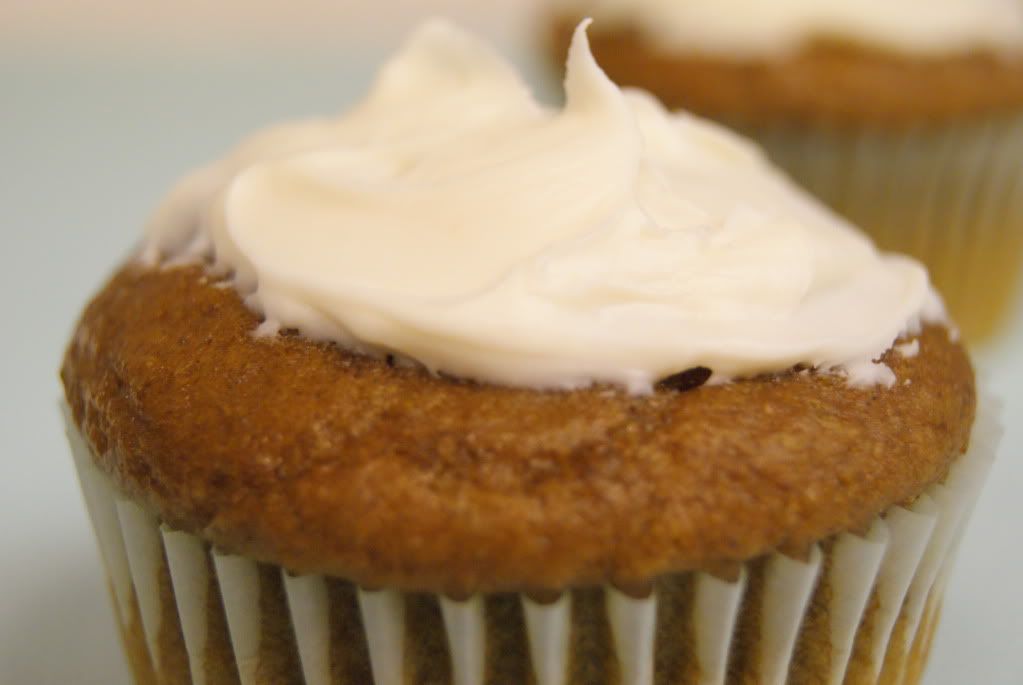
I call this one perfect cupcake

I tried to ice it using a ziploc bag, a trick I had learned from one of my several cupcake books to make swirls when you didn't have an icing bag handy. But it being my first time, I cut the hole too big, and after two hours of baking, I was far too tired to start over and find a new bag. Instead, I smoothed out a little dollop of cream cheese icing on top of the cupcake (which were pumpkin spice - a mild enough combination for it to have been a muffin) and they were done.

Almost as soon as we had cleaned up the kitchen I wanted to make more cupcakes. But my boyfriend, who had patiently kept me company while I was baking the first time around, was exhausted. Oh, and it was nearly nine o'clock, meaning that soon we wouldn't have a kitchen to use.

Cupcake fever did not reside by noon the following day.

By this point I had posted pictures of the cupcakes I made on my own wall, and I had even found a couple of people to do a baking exchange with over the holidays. All of this was just furthering my desire to make cupcakes. I tried to read my books, and that only gave me a larger desire to go make cupcakes. Or, at least, play with icing. On a related note, last night I had a dream where someone gave me icing tips and bags for Christmas, wrapped in a ziploc bag.

So now what was I going to do? I didn't have a kitchen - let alone the ingredients I wanted - to make the cupcakes. Well the answer was obvious, I opened Inkscape and started to draw. What I came out with was awesome:

And that design pretty obviously became some of my new cards, freshly listed this morning:


Also, knowing me, I'm thinking there will be many more cupcakes to come! ;-)

Sunday, November 21, 2010

We have Reopened!

Thank you for the support from everyone who came last night, and those who have helped me along the way. :)

I've also noticed that due to how I saved the images, a lot of distortion is occurring when you zoom in. So I'm in the process of updating the pictures with better quality.

Thanks again for the support, guys! I hope this year is a very successful one. :)

Friday, November 19, 2010

Turtlebug Goods and Profit

This is part of a series of blog posts concerning my business plan as well as my outlook on how I want to run Turtlebug Goods. Expect more of these up until - and beyond - the intended launch of the company! There is a relatively new theory in business planning and organization called the Triple bottom line - people, planet, and profit. This deals with profit.


Turtlebug Goods and Focus


The word 'profit' is used a lot in business, with it describing how successful a company is in general terms. It is not the only focus of Turtlebug Goods even though it plays a vital roll in the company's health, as the triple bottom line places equal pressure on people and planet on top of profit. Companies that are driven by all three tend to be more responsible socially as well as with natural resources, and both of these in turn naturally contribute to a positive bottom line. It is important to remember this, because in nature companies take a lot from a community in the way of resources as well as money paid for goods or services rendered. Part of this is an expectation that profits will be used accordingly to grow the community and the business.


Expected Sales and Profit


Fortunately, start up costs for Turtlebug Goods have been pretty low due to concise spending.. Comparatively speaking, fees and variable cost, such as ongoing ordering, will end up being much more expensive than our start up. As such, the profit margin is estimated to be at about 14%, or, $0.33 per card in profit at the forecasted price of $2.25 a card. The company will break even at the sale of 230 cards, or, in other terms, between 20-23 sets of cards sold. These numbers take into account all costs including sunk costs, materials cost, listing costs, and cost of labor. According to the government, by all means, my profit is also my income. This makes it necessary to clearly divide in my records what is profit and what is personal gain, so the division between profit and cost of labor is important for book keeping.

The greeting card and stationery market is seasonally dependent. Sales for Turtlebug Goods are forecasted to be highest in Fiscal Quarter 4, which includes October, November and December. This is because the stationery industry sees its biggest sales due to holiday cards as well as increased gift buying. The lowest Fiscal Quarter will be 1, which includes January, February and March, which traditionally has low sales in stationery and card sets (even though individual card sales for valentines day, etc. are still rather high). During these slower months, it is expected that Turtlebug Goods will take this opportunity to prepare designs for the busier quarters and to investigate new market opportunities.


Business Model

Turtlebug Goods has chosen to offer stationery, greeting cards, and other paper products in sets rather than individually. This is for a few reasons. First, printing off one card at a time is incredibly wasteful, especially if there is no directly present use for the remaining paper. It also wastes packaging, as each greeting card sold would need its own shipping envelope. On top of this, it can end up being more expensive for the customer. Currently, shipping costs in total are about $3.00. This includes proof of drop off and shipping. As such, the first ounce shipped is the most expensive, as regardless of size or weight the proof of drop off will always remain the same price. If we shipped one card at a time, it would literally double the price of a card, and that is not sustainable. However, customers can request custom packages at any time, and if it is feasible - that is, it does not violate Turtlebug Goods' triple bottom line - and in this case, smaller batches of cards will be made available per request.

Value is added to the product in a few ways. First off, all except font designs are handmade by me, with no guides or third party sources. Fonts are by Typodermic Fonts by Ray Larabie, and are licensed for proper use. Otherwise, designs are personally created and offered exclusively, with many patterns going into planned retirement on a regular basis to be replaced by new and fresh designs. Value is also added by the personal aspect of handmade products. Where it may be hard to get a custom made item from a larger corporation - especially if it involves making an entirely new design. On top of this, customers can be in more direct contact with me via Facebook, Twitter, or Etsy's modes of conversation.


Evolving Principles


Typically, as profits increase in a company, it is reinvested to help grow the company. Turtlebug Goods is no exception to this. The reason I and others like me go into business is to grow within the community. As such, there are evolving principles that Turtlebug Goods follows.
  • Support initiatives found in other pieces of the triple bottom line as it becomes possible.
  • Reinvest and explore new markets to break into, both in Paper Goods and otherwise.
  • Increase margins and become stable in the long term.
~~~~

Expect me to wrap up my triple bottom line in an upcoming blog post! Don't forget that the launch party is tomorrow, and everyone is invited!

Sunday, October 31, 2010

Happy Halloween!


Happy Halloween from Turtlebug Goods!

Friday, October 29, 2010

Turtlebug Goods and the Planet


This is part of a series of blog posts concerning my business plan as well as my outlook on how I want to run Turtlebug Goods. Expect more of these up until - and beyond - the intended launch of the company! There is a relatively new theory in business planning and organization called the Triple bottom line - people, planet, and profit. This deals with planet.

Turtlebug Goods and the Environment

Sustainability. Its practically a buzzword used in business to show that a plan will work and that it will last forever - especially when the environment is brought into question. But how do companies really affect the environment? Every industry does so in a different way with different materials. Jewelers use natural resources such as metals, minerals and rare gems while photographers use chemicals to develop their pictures. As for paper goods, the culprit is in the name: we produce products made out of paper, and paper is made out of trees. It sounds pretty hopeless once you think about it. After all, these are only the raw materials, and doesn't take into account the many tools needed to package and finish a product. But there is some good news: it is getting better, and business owners are getting more access to recycled, lower impact products now than ever before.

To state it simply: Turtlebug Goods wants to use resources efficiently and with as low of impact as possible. However, we acknowledge that where we are is not where we want to end, with the desire to make measurable progress in the years ahead.

Tools and Materials

Turtlebug Goods wants to minimize environmental impact as much as possible as soon as possible. Currently, all products will be printed on paper that is at least 30% post consumer content. As time goes on, I plan to up that until it is eventually at 100% recycled paper. I wish I could say that I could start with 100% recycled paper, but that is not economically feasible, unfortunately, at this time. However, the great news is that not only does paper biodegrade quickly, but it is also recyclable. All scrap paper will be collected and either recycled at a facility, or else made into paper by me to be used in products.

I acknowledge that a small business has a lot of competition and resistance when it comes to finding affordable but environmentally sound tools to use. However, the scale of operations works in our favor over large businesses, in that there is no large office that needs extra power for lighting and comfort control, nor is there as much in the way of large machines that require resources and so on. There are also tools made with home businesses and the environment in mind. For example, the paper cutter I will use (pictured above) has a trimmer base made of 100% recycled resin. My printer is Energy Star compliant, and Canon (the printer's manufacturer) is working on full certification with ISO 14001, and fortunately has many sites already in compliance as seen here [pdf]. Printers leave a lot of waste in their path: packaging, handbooks, and most of all - ink cartridges. These will be recycled at the nearest location.


Efficiency: The "4.25" Principle

Waste not, want not. A lot of paper can be wasted just by trimming something down to fit. Turtlebug Goods has gone to great lengths that packaging, envelopes and paper are used as efficiently as possible with minimal waste. This includes choosing product dimensions. Products are designed to intentionally to use up the entire piece of material when making the product. In the case of the primary offering, greeting cards and note cards, they are sized to use the most of a standard 8.5x11 piece of paper: two cards per each sheet. As other products are introduced, they too will be sized accordingly. The printer to be used is wide format and can feed a variety of sizes, which will be utilized to support this principle. Not only does this keep us from wasting inordinate amounts of paper or other product, it also is a more efficient use of company capital.

Efficiency is very important, especially since greeting cards can use up massive ink and paper resources. Unlike large manufacturing facilities, we are in a unique position that allows us to print only when a sale is made. Designs are stored on virtual drives and then printed when an order comes in. This allows customers to choose colors or wording, adding value to the card. On top of this, it allows us to keep stock levels low (only model cards will be printed and kept on file for posterity), conserve space and conserve paper. Its a winning situation for all parties involved.


Evolving Principles

Turtlebug Goods does not intend to stop at this point and consider it the most efficient mode of business or efficient use of valuable resources. Over time, the environmental statements will evolve to these principles:

  • Increase post consumer content in paper until it is at 100% post consumer
  • Be more efficient in ink and paper usage as needed
  • Decrease recyclable waste

~~~

This is it! What do you think, or what are you doing to help the environment?